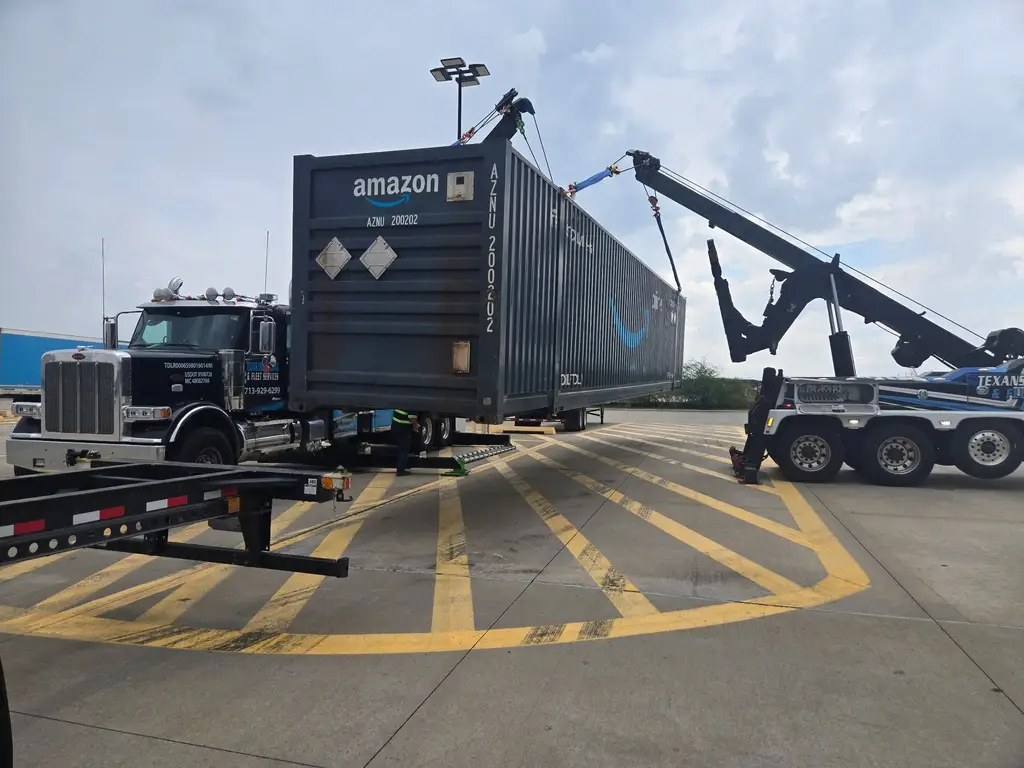
Dispatchers and site supervisors call us several times a week with the same question: do I need a crane for this, or can a rotator do it? Most of the time the answer is the rotator, faster and cheaper, and some of the time the honest answer is the crane. Here is how we decide, and how you can decide before you call anyone.
What each machine actually is
A rotator is a heavy wrecker whose boom rotates 360 degrees and is supported by hydraulic outriggers, so it can lift off the side or rear of the truck like a crane while still carrying two heavy winches, an underlift and a full rigging inventory. Ours is a 50-ton Miller Century 1150: 100,000 pounds of rated capacity with the boom retracted, dropping to about 25,000 pounds at full extension, with a maximum sheave height around 41 feet. It drives to the scene, sets up in minutes, and can lift, pull, right, drag and then tow the unit away.
A mobile crane is a dedicated lifting machine. It reaches higher and farther than any rotator, and the larger classes lift far more at long radius. It cannot winch, cannot pull a load sideways, cannot tow anything, and it arrives with a separate rigging crew, a lift plan, ground-bearing requirements, and often a permit and a road closure of its own.
Side by side
| Factor | 50-ton rotator | Mobile crane |
|---|---|---|
| Time to lift after arrival | Minutes: outriggers down, rigging on the truck | Hours: pad, counterweight, rigging crew, lift plan |
| Capacity close in | Up to 100,000 lb at short radius | Higher, depending on class |
| Capacity at long radius or height | Falls quickly past about 20 ft of extension | This is what a crane is for |
| Pulling and dragging | Dual 50,000-lb winches, snatch blocks, anchors | None; vertical lifts only |
| Righting a rolled vehicle | Designed for it: lift and rotate in one controlled motion | Possible with two cranes or a tag crane, slow |
| Towing after the lift | Same truck, same crew | A wrecker still has to come |
| Uneven or soft ground | Outrigger pads and cribbing, quick to adapt | Mats or an engineered pad |
| Permits and closures | Works under police incident management on the roadway | Lift permits, engineered plans, often a street closure |
| Regulation | Towing and recovery (TDLR); OSHA crane rule excludes wreck clearance | OSHA 1926 Subpart CC, certified operator, signal person |
| Typical cost | Hourly with a minimum, one invoice | Mobilization, minimum hours, crew, plus a separate tow |
When the rotator is the right call
- Rolled or jackknifed trucks, trailers, buses and motorhomes on any roadway. This is the machine's core job and every hour of delay is a lane closure.
- Equipment that slid off a trailer or into a ditch within about 20 feet of where the truck can set up: excavators, dozers, loaders, generators, compressors.
- Shipping containers and chassis: lifts off a tipped chassis, container swaps, stuck twist locks, containers set down in the wrong spot in a yard.
- Load shifts: lifting the trailer or the load to re-square it, then re-securing it for the road.
- Machinery lifts on and off trailers at shops, plants and yards where the pick is within the rotator's chart.
- Anything where the unit also has to be pulled, dragged, winched or towed afterward. One setup instead of three.
When you actually need a crane
When a job is crane work we say so on the first call. We would rather send you to the right machine than put a rotator at the edge of its chart on your site.
- Height: setting anything above roughly 40 feet, such as rooftop HVAC units, steel, precast and signage.
- Long radius: a heavy pick that has to happen 40, 60 or 100 feet from where a truck can park, over a building, a body of water or a live plant unit.
- Very heavy loads at radius: a loaded transformer, a large vessel or a tracked machine well over 100,000 pounds where there is no way to shorten the reach.
- Construction lifting as a scheduled part of a build. That work falls under the OSHA crane standard and belongs with a crane company, a lift plan and a certified operator.
The regulatory line
OSHA's construction crane standard (29 CFR 1926 Subpart CC) explicitly excludes tow trucks and wreckers when they are used to clear wrecks and haul vehicles, which is why a rotator can be on a freeway righting a truck an hour after the call without a lift permit. The same rotator doing a scheduled construction pick is a different situation, and a good recovery company knows where that line is. In Texas the rotator and its operator work under TDLR towing and incident-management licensing; a crane works under OSHA operator certification with a lift director and a signal person.
A quick way to decide
How high and how far?
Under about 40 feet of height and within about 20 feet of a place a truck can set up: rotator. Beyond that: crane.
How heavy, really?
Under 100,000 pounds close in, or under about 25,000 pounds at the end of the reach: rotator. Look at the unit's data plate, not a guess.
Does it need to be pulled or towed?
If the answer is yes, the rotator does both. A crane needs a wrecker anyway.
Is the clock running?
Lane closures, detention, spoiling cargo and idle crews all favor the machine that lifts within minutes of arrival.
Questions we get about this
Can a rotator replace a crane at a construction site?
For unloading and setting machinery, containers, generators and similar equipment within its chart, yes, and it is usually faster and cheaper. For scheduled structural lifts, height work, or anything that falls under the OSHA crane standard, hire a crane.
How much can a 50-ton rotator lift?
The rating is 100,000 pounds with the boom retracted and close to the truck. Capacity falls as the boom extends and rotates away from the chassis, to about 25,000 pounds at full extension. The recovery supervisor works the load chart for every lift and asks you for weights and distances for that reason.
Is a rotator cheaper than a crane?
For jobs inside its reach, almost always, because there is no mobilization charge, no separate rigging crew, no engineered pad, and no second truck to tow the unit afterward. For jobs outside its reach the comparison does not exist; you need the crane.
Do you offer crane service?
We offer rotator lifting, which handles most of what Houston calls about as crane work: containers, machinery, equipment on and off trailers, and stuck or tipped units. When your job is genuinely crane work we tell you on the phone.