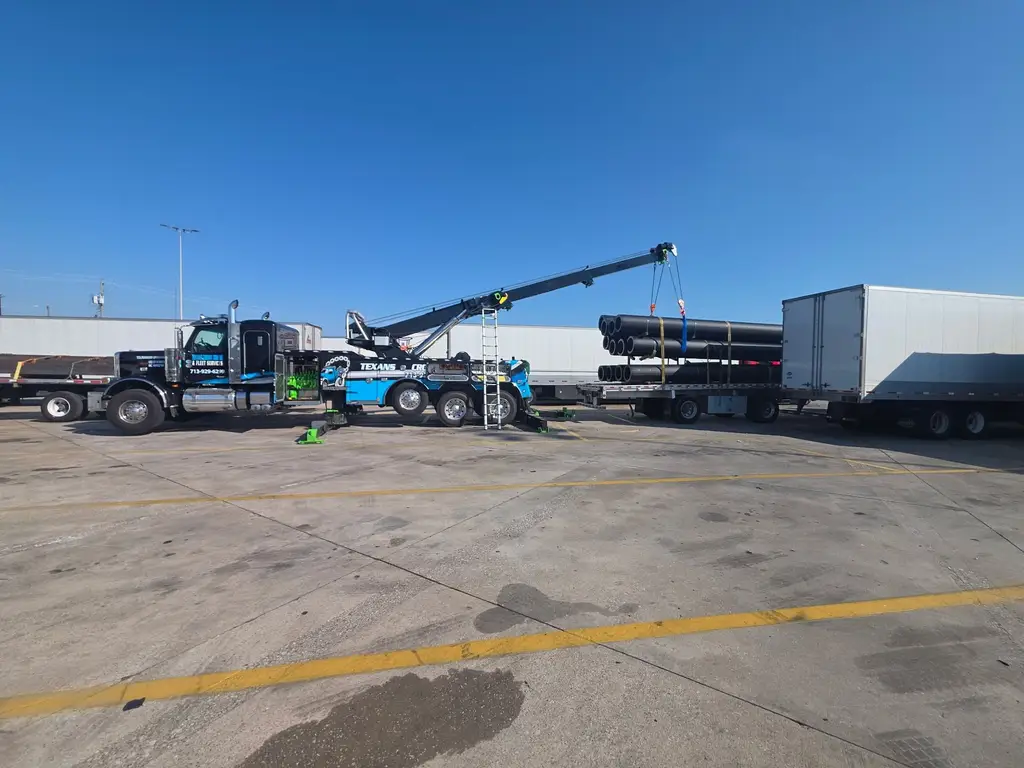
A trailer leaning on a Houston freeway ramp generates two very different phone calls. One ends with the load re-squared and re-secured on the shoulder in a couple of hours. The other ends with a second trailer, a forklift crew, and the freight moved piece by piece. Knowing which one you have before you call saves money on both.
Definitions
A load shift is cargo that has moved inside or on the trailer but is still fundamentally on the trailer: coils that rolled, pipe that walked forward, pallets that slid to one wall, machinery that broke a chain and turned. The trailer is upright and roadworthy and the load can be brought back into a legal, secured position. A load shift service corrects the position and re-secures the cargo so the truck can finish the run.
A load transfer is moving the freight off that trailer onto another one, because the trailer cannot legally or safely carry it any farther: structural damage, a rollover, a breached roof or wall, contaminated or crushed product, an axle-weight problem that cannot be fixed by repositioning, or a reefer that can no longer hold temperature. A transfer is a logistics operation with equipment, labor and a receiving trailer, and it takes much longer.
How a rotator fixes a load shift
Stabilize
Chock, crib and, if the trailer is leaning, take the weight with the rotator before anyone opens a door or cuts a strap. A leaning load can finish the fall when the tension is released.
Lift and re-square
Depending on the load, the rotator lifts the cargo itself with slings or lifts the trailer to let gravity bring the load back, while the crew guides it. Heavy coils, pipe, lumber and machinery are lifted; palletized freight is usually pushed and re-stacked from inside.
Re-secure to the rule
Cargo securement under 49 CFR 393.100 through 393.136 sets the working-load limits and the number of tie-downs by length and weight. We re-secure to that standard with new straps, chains, edge protectors and blocking so the truck passes the next inspection.
Document and release
Photos before and after, a note of what was replaced, and the truck continues on its route. Typical time on scene is one to three hours.
When it becomes a transfer
- The trailer is damaged: bent frame, broken crossmembers, a wall or roof that has opened, a floor that has failed under a wheel.
- The unit rolled. Uprighting a loaded trailer is sometimes possible, but most rollover recoveries start with getting the cargo out safely.
- The freight is compromised: crushed, wet, contaminated, or hazardous product that has breached its packaging.
- Weight cannot be legalized by repositioning, or the shipper loaded the trailer in a way that can never be secured to the rule.
- A reefer that cannot be restarted and a load that cannot wait for a repair.
- A regulator says so: a DPS or enforcement officer who places the vehicle out of service for a securement violation may require the load to be corrected or removed before it moves.
What a transfer involves
A transfer needs a receiving trailer of the right type, the means to move the freight (forklift, pallet jacks, slings and the rotator for heavy pieces), a labor crew, and a place to do it. On the roadside it means traffic control and slow, careful work; at a yard, dock or our facility it goes much faster. Reefer loads need continuous temperature. Hazmat loads need a licensed contractor for the product and a plan approved by the agency on scene. Plan on four to eight hours for a full van, more for a loaded flatbed with heavy pieces, plus the recovery of the original trailer.
Where it happens around Houston
Load shifts cluster where trucks brake and turn hard: the ramps between I-610 and I-10, I-45 and US-59 downtown, the Beltway 8 and Sam Houston Tollway interchanges, the curves on SH-225 coming out of the plants, and the last mile into the container terminals at Barbours Cut and Bayport where a chassis hits a rough grade crossing. Pipe and steel shift on the way out of the Ship Channel yards; lumber and building products on US-290 and I-10 West; produce and packaged goods anywhere a driver has to stand on the brakes in stop-and-go traffic.
Time and cost, compared
| Factor | Load shift correction | Load transfer |
|---|---|---|
| Units on scene | Rotator or heavy wrecker, one crew | Rotator, receiving trailer, forklift, labor crew, often a support wrecker |
| Typical time | 1 to 3 hours | 4 to 8 hours, longer for heavy or hazmat loads |
| Where the freight ends up | On the same trailer, re-secured | On a new trailer, or in storage pending the cargo claim |
| Billing | Hourly with a minimum, consumables itemized | Hourly per unit and per person, plus trailer, storage and pass-throughs |
| What the driver needs | Keys, BOL, securement gear on the truck | Cargo owner decisions, a destination, and patience |
What to tell dispatch
- What the load is, how heavy, and how it was secured.
- What moved and how far: leaning trailer, coil against the bulkhead, pallets down one side.
- Whether the trailer is damaged or opened anywhere.
- Where the truck is stopped and whether it is safe to work there.
- Whether an officer has placed the vehicle out of service or is waiting on the correction.
Questions we get about this
Can you re-secure the load on the roadside so the driver can keep going?
When the trailer is sound and the cargo is intact, yes. That is the point of load shift service: correct the position, re-secure to the federal standard, document it and release the truck. If the trailer or the cargo is compromised we tell you it is a transfer and why.
Do you supply the receiving trailer for a transfer?
We coordinate one for most van and flatbed loads, or work with the trailer your carrier sends. For specialized equipment such as tankers or reefers with specific requirements, tell dispatch up front so the right trailer is on the way with the crew.
Who pays for a load shift service?
The motor carrier is billed and usually recovers under its physical-damage or cargo coverage depending on what was damaged. A load that shifted because of how the shipper loaded it can become a claim against the shipper; our photos and report document how the load was found.
Will you handle a load that has been placed out of service by DPS?
Yes. We correct the securement to the standard the officer cites, document it, and the driver presents the correction for re-inspection before moving.